Despite growing regulatory emphasis on user data rights, individuals struggle to develop meaningful ownership over their personal data due to its intangible nature and complex technical infrastructure. Current privacy self-management approaches inadequately address users' psychological needs for control and ownership, typically burdening users rather than facilitating meaningful engagement. This PhD research reconceptualises data ownership through Psychological Ownership (PO) theory, positioning users in an active data manager role rather than as passive recipients of privacy controls.
Following a Design Science Research framework, this research comprises three sequential studies that progressively build understanding of human-centred data management. The first study employed a mixed-methods analysis of 25 semi-structured interviews and 1,757 Terms of Service annotations from 42 major online service providers, revealing that only 28.8% of current industry practices actively support user ownership. Through iterative template analysis guided by PO theory's three antecedents – Control, Intimate-Knowledge, and Self-Investment – this study developed the Data Service System (DSS) framework, identifying six key data management practices that users desire to engage with meaningfully. The second study experimentally validated the DSS framework through a between-subjects design with 556 participants across healthcare and social media contexts. Participants experiencing interfaces that implemented PO antecedents demonstrated statistically significant increases in ownership feelings, while reducing perceptions of online service provider dominance. These findings challenge zero-sum assumptions about user empowerment versus institutional capability.
The third study extended individual PO principles to collective data governance through Research through Design methodology, developing the Compliance Rating Scheme framework for generative AI datasets. This framework demonstrated how individual ownership can be preserved within large-scale systems through provenance tracking and governance mechanisms. This PhD research contributes theoretical advances extending PO theory to digital contexts, practical frameworks enabling human-centred data management, and methodological innovations bridging psychology with technology design.

Generative Artificial Intelligence (GAI) has experienced exponential growth in recent years, partly facilitated by the abundance of large-scale open-source datasets. These datasets are often built using unrestricted and opaque data collection practices. While most literature focuses on the development and applications of GAI models, the ethical and legal considerations surrounding the creation of these datasets are often neglected. In addition, as datasets are shared, edited, and further reproduced online, information about their origin, legitimacy, and safety often gets lost.
To address this gap, we introduce the Compliance Rating Scheme (CRS), a framework designed to evaluate dataset compliance with critical transparency, accountability, and security principles. We also release an open-source Python library built around data provenance technology to implement this framework, allowing for seamless integration into existing dataset-processing and AI training pipelines across multiple data modalities, including images, video, audio, and 3D assets.
The library is simultaneously reactive and proactive, as in addition to evaluating the CRS of existing datasets, it equally informs responsible scraping and construction of new datasets.

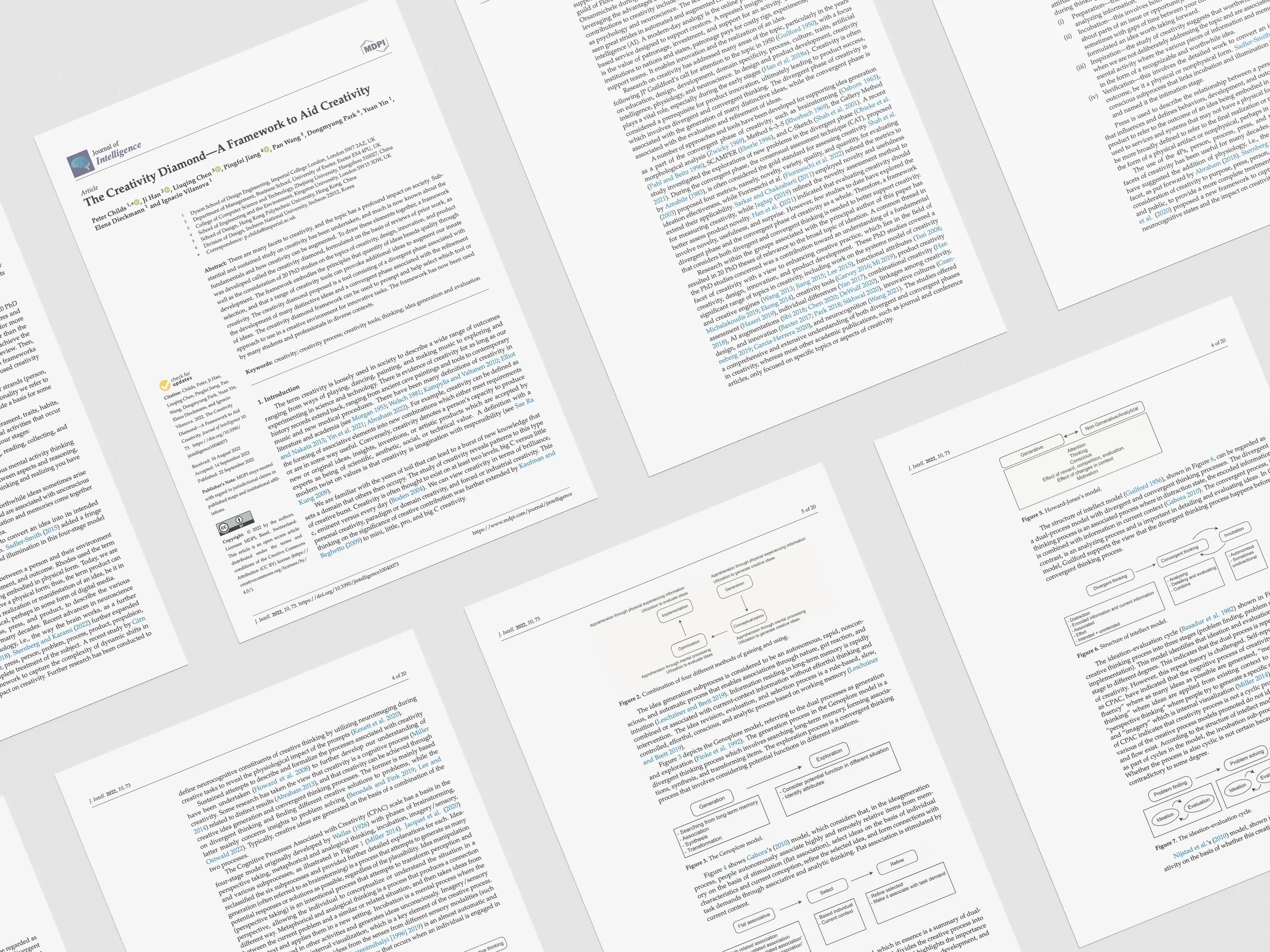
There are many facets to creativity, and the topic has a profound impact on society. Substantial and sustained study on creativity has been undertaken, and much is now known about the fundamentals and how creativity can be augmented. To draw these elements together, a framework was developed called the creativity diamond, formulated on the basis of reviews of prior work, as well as the consideration of 20 PhD studies on the topics of creativity, design, innovation, and product development.
The framework embodies the principles that quantity of ideas breeds quality through selection, and that a range of creativity tools can provoke additional ideas to augment our innate creativity. The creativity diamond proposed is a tool consisting of a divergent phase associated with the development of many distinctive ideas and a convergent phase associated with the refinement of ideas.
The creativity diamond framework can be used to prompt and help select which tool or approach to use in a creative environment for innovative tasks. The framework has now been used by many students and professionals in diverse contexts.
Seasonal immunization is essential for safeguarding public health by preventing the spread of infectious disease and reducing the burden on healthcare systems. However, changes in vaccination policy may have significant implications on public confidence and vaccine uptake. This qualitative thematic analysis aimed to understand how changing government policy on vaccination eligibility impacted decision making among 50–64 year olds in England and Scotland. Semi-structured interviews were conducted with 40 adults aged 50 to 64 residing in England or Scotland, including both vaccinated and unvaccinated individuals for influenza and COVID-19, representing diverse socio-demographic backgrounds.
Four key themes emerged: (1) perceived importance of seasonal vaccines with notable differences between COVID-19 and influenza vaccines; (2) knowledge gaps and confusion regarding eligibility criteria; (3) influences on vaccine uptake such as convenience, trust and social factors; and (4) consideration for future policy, emphasizing consistency, clear rationale, and responsible use of National Health Service (NHS) resources.
While trust in the NHS was generally high, policy inconsistencies diminished confidence and created uncertainty about vaccine necessity. These findings provide critical insights into specific strategies policymakers should adopt such as habitual versus intention vaccination, wider perceptions linked to vaccination necessity, and the need for clear rationale and consistent messaging. Addressing these factors could help improve public trust, clarify rationale around eligibility and increase overall vaccine uptake.